Bridging the Gap from Classroom to Clinical
by Kaplan Nursing | June 5, 2026

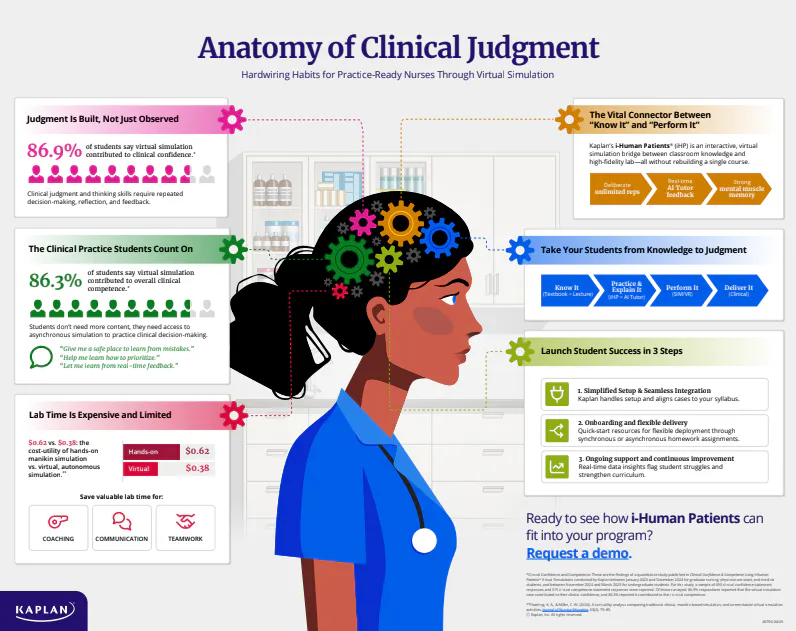
Nursing educators today face a familiar challenge: students often struggle to translate textbook knowledge into the split-second decision-making required at the bedside. Traditional lab time is increasingly expensive and limited, making it difficult to provide the repeated practice necessary to "hardwire" clinical habits. The attached infographic highlights how virtual simulation serves as the vital connector between "knowing" and "performing," allowing students to build clinical judgment through a deliberate, asynchronous environment.
Kaplan’s i-Human Patients (IHP) provides an interactive bridge that integrates into existing curricula without requiring a total course redesign. By offering unlimited practice opportunities and real-time AI Tutor feedback, IHP allows students to learn safely from mistakes and master prioritization before they ever step into a high-fidelity lab or clinical setting. This approach doesn't just add content; it provides the "safe place" students are asking for to develop their mental muscle memory.
The data underscores the effectiveness of this model, with 86.9% of students reporting that virtual simulation contributed to their clinical confidence. Furthermore, with the cost-utility of virtual simulation being significantly lower than hands-on manikin training ($0.38 vs. $0.62), programs can preserve valuable lab time for high-impact activities like coaching, communication, and teamwork. Explore the infographic below to see how a three-step integration process can launch your students toward practice-ready success.
For a visual overview, download the free infographic.