
Using Bloom's Taxonomy to Develop Clinical Judgment in Nursing Students
by Dr. Christi Doherty DNP, RNC-OB, CNE, CHSE, CDP, Executive Director, Nursing & i-Human Patients | August 10, 2026

If you've been teaching for any length of time, you've probably had this thought halfway through the semester: "There is no way I'm going to get through all of this content." Healthcare continues to evolve at an incredible pace. New evidence emerges, technology advances, and every topic feels essential. As nurse educators, we naturally want to prepare our students for everything they might encounter in practice. The challenge is that covering more content doesn't always lead to deeper learning.
Many of our students can memorize laboratory values, identify medication classes, and answer straightforward knowledge questions. Yet when they're faced with an unfolding patient situation or a complex simulation, they often struggle to connect the pieces together. They know the facts, but they aren't always sure what those facts mean, which assessment findings matter most, or what they should do next. That's the difference between knowing information and developing clinical judgment.
This is why Bloom's Taxonomy (Anderson & Krathwohl, 2001; Bloom, 1956) remains one of the most valuable teaching frameworks available to nurse educators. Rather than viewing it as an educational theory we learned in graduate school, we can use it as a practical guide for helping students progress from remembering information to applying knowledge, analyzing clinical cues, evaluating patient responses, and ultimately making sound clinical decisions. That progression not only supports success on today's NCLEX®, which emphasizes clinical judgment, but also prepares graduates to care for increasingly complex patients with confidence.
[ READ NEXT: Incorporating Bloom's Taxonomy in Nursing Curricula ]
What Bloom’s Taxonomy Looks Like in Nursing Education
One of the reasons Bloom's has remained such a valuable framework is that it reflects how students naturally progress from learning information to thinking like nurses. Each level builds on the one before it. Students need a strong knowledge foundation, but our ultimate goal is to help them use that knowledge to make safe clinical decisions (Billings & Halstead, 2024; Oermann et al., 2025).
- Remembering: Learning begins with foundational knowledge. Students memorize normal laboratory values, medication classifications, and the Rights of Medication Administration. Although memorization alone does not prepare students for practice, it provides the essential knowledge needed to build clinical judgment.
- Understanding: Students move beyond memorization by explaining concepts in their own words. They may describe how renal failure contributes to fluid retention or explain complex medical information to a patient using language that is clear and easy to understand.
- Applying: Knowledge becomes action. Students calculate medication dosages, perform sterile procedures, administer medications safely, and implement nursing interventions during skills labs, simulation, and clinical experiences.
- Analyzing: Clinical judgment begins to develop as students recognize meaningful clinical cues, distinguish relevant findings from less important information, and determine priorities for care. For example, they may differentiate expected postoperative discomfort from signs of compartment syndrome or determine whether shortness of breath is more consistent with heart failure or chronic obstructive pulmonary disease.
- Evaluating: Students determine whether their nursing interventions were effective. They reassess patients, interpret changes in assessment findings, and decide whether the plan of care should continue, be modified, or require communication with the healthcare provider. They begin asking not only, "What did I do?" but also, "Did it work?"
- Creating: At the highest level, students integrate knowledge from multiple areas to solve complex problems and develop individualized plans of care. This may include designing a comprehensive discharge plan for a patient with multiple chronic conditions, developing patient education that addresses health literacy, or proposing a quality improvement initiative to improve patient outcomes.
As nurse educators, our challenge is not simply helping students move through these levels. It is intentionally designing learning experiences that encourage progression from remembering information to applying knowledge, exercising clinical judgment, and confidently making decisions that improve patient care.
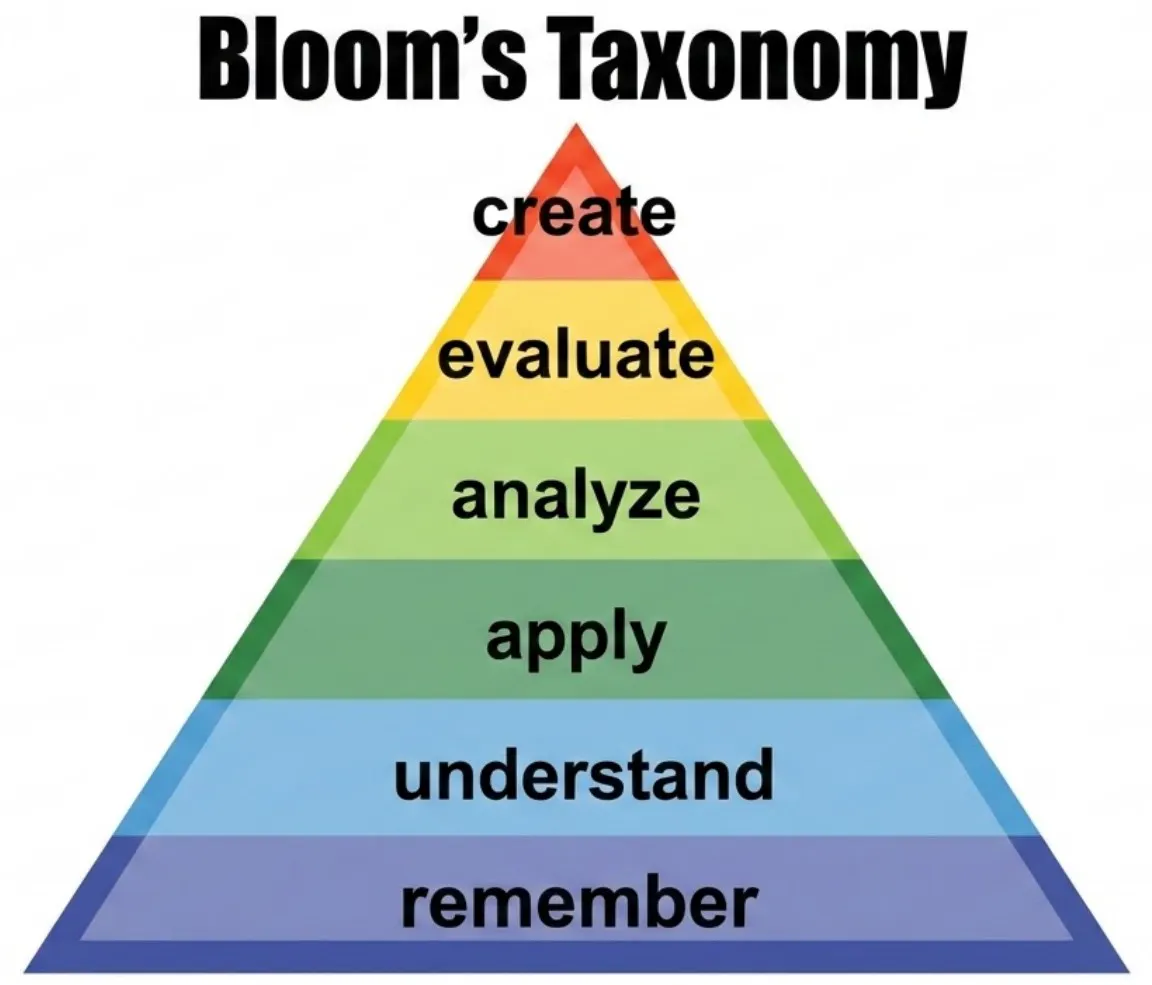
"Bloom's Taxonomy" by Vanderbilt University Center for Teaching
Aligning Learning Objectives, Teaching Strategies, and Assessments
One of the easiest mistakes to make as nurse educators is unintentionally teaching at one cognitive level while assessing at another. We may facilitate rich classroom discussions, use simulation, and encourage clinical judgment throughout a course, only to write an exam that measures simple recall. The opposite can happen, too. We expect students to analyze complex patient scenarios on an exam, but we haven't given them opportunities to practice that level of thinking during class.
A helpful strategy is to take a single concept and intentionally build learning activities across Bloom's levels. Heart failure is a great example because students revisit it throughout the curriculum while progressively developing deeper clinical reasoning.
Bloom's Taxonomy Level | Target Verbs | Practical Nurse Educator Strategy |
|---|---|---|
Remembering | List, Define, Select | Assign flashcards for common heart failure medications (e.g., ACE inhibitors, loop diuretics). |
Understanding | Summarize, Explain, Describe | Ask students to map out how reduced cardiac output triggers the renin-angiotensin-aldosterone system (RAAS). |
Applying | Execute, Solve | Have students demonstrate accurate fluid intake/output calculations and daily weight tracking in the lab. |
Analyzing | Differentiate, Compare | Present a case study where students must separate respiratory cues (e.g., COPD) from cardiac cues (e.g., heart failure). |
Evaluating | Assess, Critique | In simulation, have students reassess a patient post-diuretic and modify the care strategy based on urine output and BP trends. |
Creating | Develop, Design | Assign groups to build an individualized, multidisciplinary discharge education toolkit for a patient returning home. |
Notice that the topic never changes. What changes is the level of thinking we ask of our students.
Three Simple Shifts to Encourage Higher-Order Thinking
Moving students away from passive memorization doesn't require overhauling your entire curriculum overnight. Often, subtle tweaks to your daily classroom language and testing style can make a massive difference in how students process information.
1. Turn Clinical Findings into "Calls to Action"
Rather than listing disease features on a slide and having students copy them down, treat every clinical sign as an immediate trigger to act. For example, instead of stating, "Heart failure causes dyspnea," try prompting your class with actionable questions:
- "When your patient is dyspneic, what does that look like physically at the bedside?"
- "How will you assess the severity of this finding?"
- "What is your priority nursing intervention, and what would concern you most?"
This simple shift forces students to stop viewing symptoms as static facts to memorize and start processing them through an active clinical lens.
2. Write Test Items That Reflect Real Practice
Licensing exams measure safe entry-level practice by evaluating decision-making under pressure, not memory capacity. Align your internal assessments with this expectation by shifting from recall items to priority analysis.
- Lower-Tier Recall: "What is the therapeutic aPTT range for a patient receiving a continuous heparin infusion?"
- Bloom's-Elevated Analysis: "A patient receiving a continuous heparin infusion has an aPTT of 105 seconds. Which action should the nurse perform first?"
Incorporate priority language into your question stems, such as initial action, highest priority, or best judgment. This language conditions students to weigh competing clinical needs under exam conditions just like they will at the bedside.
3. Encourage Students to Study Using Course Objectives
Learning objectives shouldn't just be a checklist at the top of a syllabus or lecture slide. Show your students how to use those objectives as active self-assessment tools after every reading assignment or class session.
Teach them to revisit each objective and ask themselves:
- "Can I explain this concept in my own words without looking at my notes?"
- "Can I apply this knowledge to an unfolding patient scenario?"
- "Can I justify why I chose one intervention over another?"
When students treat learning objectives as study prompts, they begin practicing the exact type of critical reasoning expected in simulation, clinical practice, and on the NCLEX exam.
Bringing It All Together
At the end of the day, operationalizing Bloom's Taxonomy isn't about adding more work to our already full plates; it's about making our teaching more intentional. By auditing our item banks, scaffolding our case studies, and asking debriefing questions that demand real justification ("What specific cues made you prioritize the airway first?"), we help our students make the leap from "parroting" content to confident, clinically grounded judgment.
References
- Anderson, L. W., & Krathwohl, D. R. (2001). A taxonomy for learning, teaching, and assessing: A revision of Bloom’s taxonomy of educational objectives. Longman.
- Bloom, B. S. (Ed.). (1956). Taxonomy of educational objectives: The classification of educational goals. Handbook I: Cognitive domain. David McKay Co Inc.
- Oermann, M. H., & Gaberson, K. B, De Gagne, J. C. (2025). Evaluation and testing in nursing education (7th ed.). Springer Publishing Company.
- Billings, D. M., & Halstead, J. A. (2024). Teaching in nursing: A guide for faculty (7th ed.). Elsevier.
Dr. Christi Doherty is the Executive Director of Nursing & i-Human Patients at Kaplan North America. Dr. Doherty is a skilled researcher, valued professor of nursing, experienced clinical nurse, and designer of virtual simulations. She has earned certifications in nursing education, healthcare simulation education, diversity, and inpatient obstetrics. Dr. Doherty has published several books and journal articles and presented nationally and internationally on diverse subjects such as clinical judgment, mentorship, simulation, and students' engagement in statistics and informatics.