

Average Doctor Salaries by Specialty
- In 2025, the average salary for all U.S. physicians, including Primary Care Physicians and Specialists, was $386k.
- The average doctor salary grew roughly 3% from 2024 to 2025.
- Orthopedics & Orthopedic Surgery was the top-paying medical specialty in 2025, with an average annual salary of $611k.
The average salary of a doctor is an important consideration when deciding which medical field you want to specialize in or whether you want to pursue a medical degree. There are many factors to weigh when considering specialties, and understanding how much money different types of doctors make per year can help with financial planning and give you an estimate of when you can expect to pay off your medical school loans. This guide discusses the highest and lowest-paying salaries for doctors by specialty and which U.S. cities and states pay their doctors the best.
[ READ NEXT: The Prerequisites for Medical School ]
TABLE OF CONTENTS
- How much do doctors get paid?
- Average Annual Doctor Salary by Specialty
- Top 10 Earning States for Doctors
- Lowest Earning States for Doctors
- Medical Specialties with the Largest Increase in Compensation
- Physician Gender Pay Gap
- Preparing for Medical School
- Choosing a Medical Specialty
How much do doctors get paid?
According to the 2026 MedScape Physician Compensation Report, doctor salaries rose moderately in 2025. Last year, Primary Care Physicians (PCPs) in the United States earned an average of $298,000, while Specialists earned an average of $417,000. However, the average income for a doctor varies widely depending on their specialty and where they live in the U.S. Below, we list the average annual compensation by medical specialty so you can see which types of doctors get paid the most.
[ RELATED: How Long Does It Take to Become a Doctor? ]
Average Annual Doctor Salary by Specialty
Here are the top-paying medical specialties, ranked by average annual income:
- Orthopedics & Orthopedic Surgery: $611,000
- Cardiology: $575,000
- Radiology: $571,000
- Plastic Surgery: $554,000
- Anesthesiology: $543,000
- Urology: $535,000
- Gastroenterology: $530,000
- Otolaryngology: $508,000
- Oncology & Hematology: $464,000
- Dermatology: $448,000
- Ophthalmology: $446,000
- General Surgery: $442,000
- Critical Care: $427,000
- Emergency Medicine: $421,000
- Pulmonary Medicine: $395,000
- Pathology: $394,000
- Ob/Gyn: $390,000
- Physical Medicine & Rehabilitation: $359,000
- Nephrology: $359,000
- Neurology: $341,000
- Psychiatry: $331,000
- Allergy & Immunology: $310,000
- Internal Medicine: $307,000
- Family Medicine: $288,000
- Diabetes & Endocrinology: $284,000
- Rheumatology: $284,000
- Infectious Diseases: $282,000
- Public Health & Preventive Medicine: $277,000
- Pediatrics: $266,000
Source: MedScape Physician Compensation Report, 2026
Top 10 Earning States for Doctors
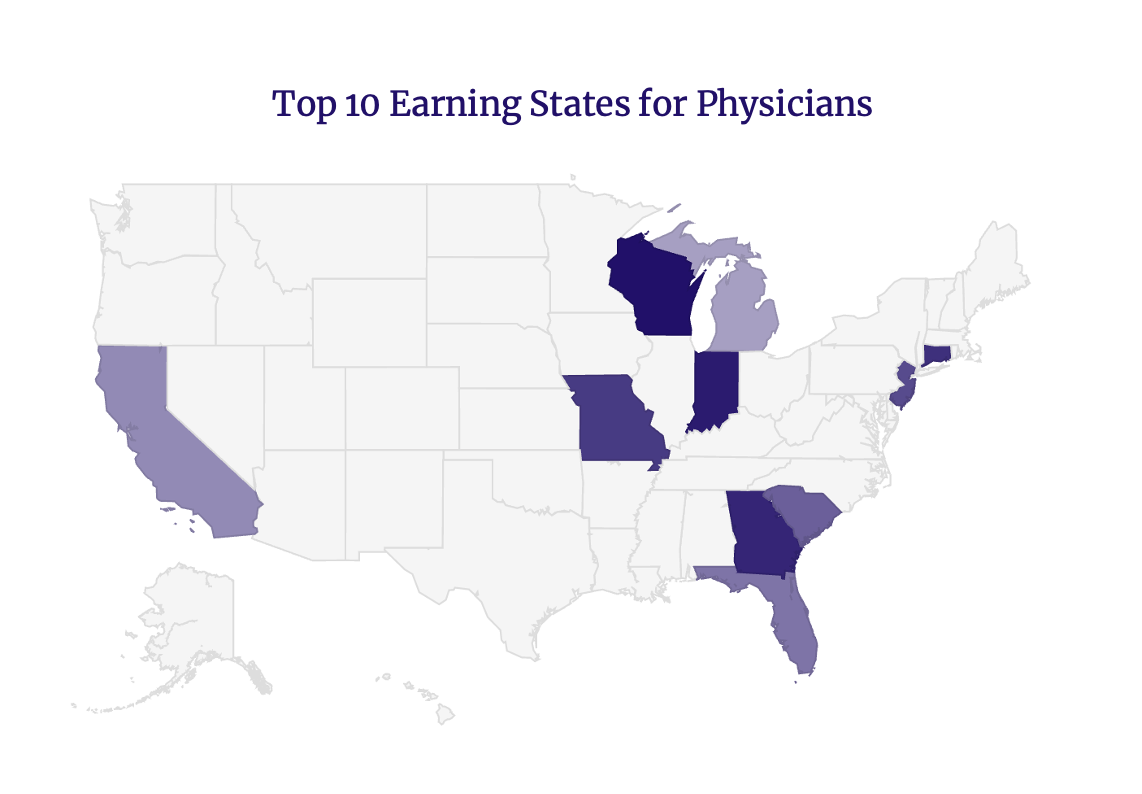
Here are the top 10 earning states in the U.S. for doctors:
- Wisconsin: $397,000
- Indiana: $372,000
- Georgia: $363,000
- Connecticut: $362,000
- Missouri: $361,000
- New Jersey: $360,000
- South Carolina: $360,000
- Florida: $359,000
- California: $358,000
- Michigan: $356,000
Source: MedScape Physician Compensation Report, 2023
Top Earning Metro Areas/Cities for Doctors
The numbers above represent state-wide averages. Average salaries for doctors in metropolitan areas tend to be higher. Here are the top 10 metro areas where doctors are paid the highest average annual salary:
- Rochester, MN: $495,532
- St. Louis, MO: $484,883
- Los Angeles, CA: $470,198
- San Jose, CA: $469,878
- Sacramento, CA: $460,671
- Phoenix, AZ: $459,082
- Riverside, CA: $455,986
- Minneapolis, MN: $452,598
- San Francisco, CA: $449,830
- Charlotte, NC: $448,400
Source: Doximity 2025 Physician Compensation Report
Lowest Earning States for Doctors
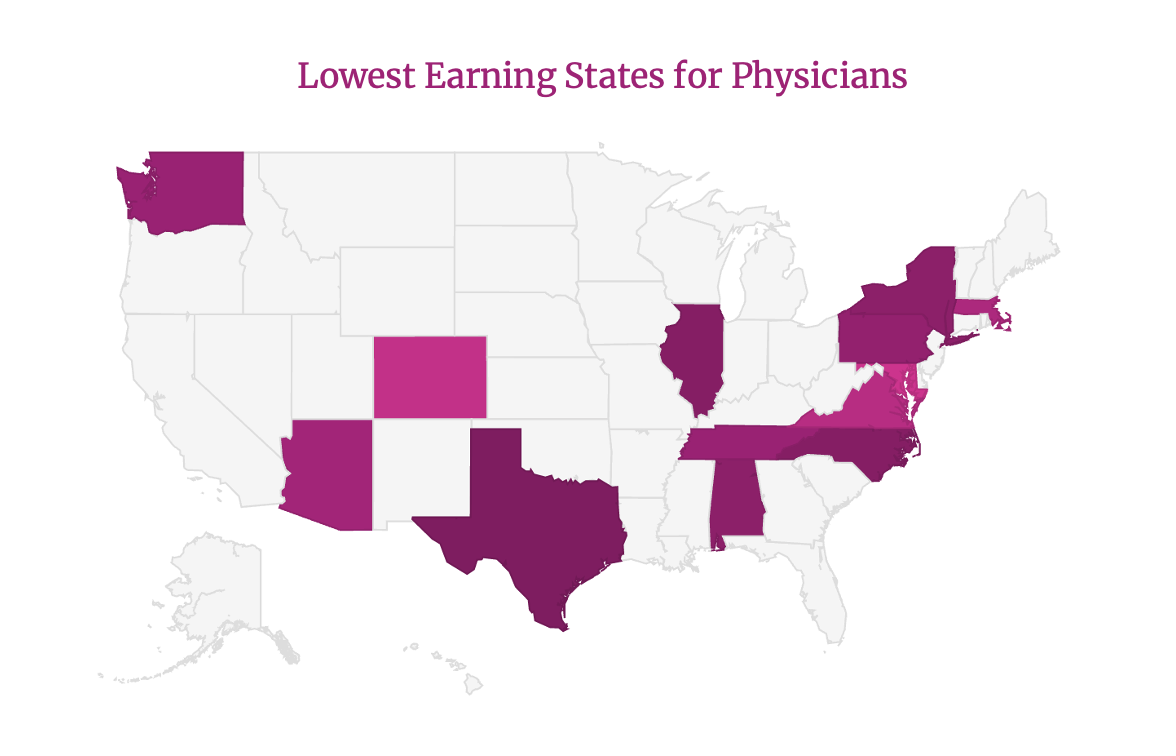
Here are the lowest earning states in the U.S. ranked by income for doctors:
- Maryland: $306,000
- Colorado: $327,000
- Virginia: $330,000
- Massachusetts: $331,000
- Arizona: $334,000
- Washington: $338,000
- Tennessee: $340,000
- Pennsylvania: $344,000
- Alabama: $348,000
- New York: $348,000
- Illinois: $350,000
- North Carolina: $350,000
- Texas: $353,000
Source: MedScape Physician Compensation Report, 2023
Lowest Earning Metro Areas/Cities for Doctors
Here are the ten lowest earning metro areas for doctors in the U.S.
- Durham-Chapel Hill, NC: $358,782
- Rochester, NY: $364,160
- Ann Arbor, MI: $373,154
- Charleston, SC: $384,419
- Washington, DC: $386,731
- Providence, RI: $386,788
- San Antonio, TX: $389,495
- Boston, MA: $390,799
- Baltimore, MD: $392,507
- Worcester, MA: $397,188
Source: Doximity 2025 Physician Compensation Report
Medical Specialties With the Largest Increase in Compensation in 2025
While many doctor salaries by specialty have risen, some specialties saw a larger increase in 2025. According to MedScape, six specialties have seen at least an 8% increase in compensation compared to the previous year: Cardiology, Ophthalmology, Radiology, Emergency Medicine, Anesthesiology, and Orthopedics & Orthopedic Surgery. On the other hand, Psychiatry and Allergy & Immunology saw the largest dips in pay with a 3% decrease in salary in 2025.
Physician Gender Pay Gap
The gender pay gap continues to exist in medicine, paralleling a national trend across all fields. According to the 2026 MedScape Physician Compensation Report, the overall gender pay gap for physicians has widened in the past few years, with male physicians earning an average of $429,000 compared to their female counterparts only earning $327,000.
The Doximity 2025 Physician Compensation Report reported that in 2024, consistent with previous years, men have higher compensation than women in all medical specialties. The specialty with the largest gender pay gap was Pediatric Nephrology, with male physicians making an average of $288,974 compared to $241,239 for female physicians. In 2024, the medical specialties with the smallest gender pay gaps included Neurosurgery, Physical Medicine/Rehab, Infectious Disease, Endocrinology, and Oncology.
Preparing for Medical School
Becoming a doctor, regardless of specialty, is a multi-step process that typically begins in high school when you decide to attend an accredited university as a premed student. In order to get into medical school and eventually earn your medical license, you must first take premed classes during your undergraduate years and pass the MCAT.
Earning a good score on the MCAT is a major achievement and a critical step on your journey to medical school. Enrolling in MCAT prep is a great way to boost your MCAT score and feel confident on test day. It’s important to practice for the exam with realistic MCAT practice tests so you feel prepared. Doing well on the MCAT will make your medical school application more competitive and increase your chances of getting into your top-choice medical school.
The first step toward becoming a doctor is preparing for and passing the MCAT. Take our quick pop quiz to see how you would do on the MCAT.
Choosing a Medical Specialty
Although you likely won’t choose a specialty until you are well into medical school, you can take advantage of shadowing opportunities to not only gain clinical experience for your application to medical school but also to learn more about the specialties and get a feeling for the day-to-day life of various physicians. It’s important to note that the specialties listed above do not constitute an exhaustive list. The AAMC provides a full list of medical specialties on their website. The number of specialties and potential careers can be overwhelming at first. But as you continue on your journey to med school and residency, you’ll learn more about all of the various opportunities for a career in medicine and discover the type of doctor you want to be.
Written by Kaplan experts, reviewed by Rich Maraggio, Executive Director, Pre-Health Programs at Kaplan North America. Rich has worked on the MCAT for over a decade and has assisted thousands of pre-med students. He holds a B.A. in Economics from Union College.