

What Is a Good SAT Score? (2026)
- A good SAT score is 1350 or higher, which would put you in the top 10% of test takers.
- The average SAT score is around 1050, and a “perfect” score on the SAT is the maximum score of 1600.
- Every college and university has its own unique SAT score range, which should be consulted when determining what a “good” score is for you.
- Your SAT score does not determine if a college will accept you, but a high score can make you a more competitive applicant.
A good SAT score is subjective, ultimately depending on which colleges and universities you are applying to. Your SAT score is far from the only factor considered in your application. Each school views your application holistically, meaning that other factors such as GPA, extracurriculars, and who you are as a person will also come into play. However, earning a high SAT score will make you stand out to college admissions officers and can increase your chances of getting a college scholarship.
Keep reading to learn about current SAT scores for top universities and how the SAT scoring system works so you can understand what a good SAT score is and set your exam goals.
TABLE OF CONTENTS
- SAT Scores for Ivy League Schools
- SAT Scores for Top Universities in the U.S.
- SAT Scores for Top Liberal Arts Colleges in the U.S.
- How does SAT scoring work?
- SAT Score Ranges & Percentiles
- Does my SAT score determine which college will accept me?
- How to Set a Target SAT Score
- How to Improve Your SAT Score
- SAT Preview Quiz
- SAT/ACT Score Conversion Calculator
SAT Scores for Ivy League Schools
The eight private universities that comprise the Ivy League are some of the most competitive universities in the U.S. Earning a good SAT score is an important factor in gaining acceptance into an Ivy League School. A competitive score for any of the Ivy League schools is a score of about 1560 (out of 1600). The table below shows the SAT score ranges and acceptance rates for Ivy League schools.
| IVY LEAGUE SCHOOL | TYPICAL SAT SCORE RANGE | ACCEPTANCE RATE |
| Brown University | 1470-1550 | 6% |
| Columbia University | 1510-1560 | 4% |
| Cornell University | 1510-1560 | 8% |
| Dartmouth College | 1510-1560 | 5% |
| Harvard University | 1510-1580 | 4% |
| Princeton University | 1470-1560 | 4% |
| University of Pennsylvania | 1510-1570 | 5% |
| Yale University | 1480-1560 | 5% |
Sources: College Board BigFuture & U.S. News
SAT Scores for Top Universities in the U.S
In addition to the Ivy League SAT scores listed above, you may be wondering about scores needed for other competitive universities across the U.S. Read on for information about SAT scores needed for top universities.
SAT Score Needed for Stanford University
Students who gain acceptance into Stanford University typically have an SAT score in the range of 1510 to 1570. Stanford is a university in Palo Alto, CA that is influenced by the innovative environment provided by neighboring Silicon Valley. Stanford has under 8,000 undergraduate students and a 6:1 student-to-faculty ratio, giving it a small, liberal arts college feel.
SAT Score Needed for Duke University
Students who gain acceptance into Duke University typically have an SAT score in the range of 1520 to 1570. Duke is the 5th largest research university in the United States based on research funding, and over half of Duke undergraduates complete faculty-mentored research projects. This Durham, NC school encourages students to take a variety of courses, and students can choose from a long list of majors and minors or even, in some circumstances, design their own degree program that fits their interests.
SAT Score Needed for John Hopkins University
Students who gain acceptance into Johns Hopkins University typically have an SAT score in the range of 1530 to 1560. Johns Hopkins, located in downtown Baltimore, is a research-based university with an emphasis on academic freedom. The university offers over 50 majors and minors and has a 6:1 student to faculty ratio.
SAT Score Needed for NYU
Students who gain acceptance into New York University (NYU) typically have an SAT score in the range of 1480 to 1550. NYU is a private research university with campuses in New York, Abu Dhabi, and Shanghai. The university comprises 20 schools and colleges and has a student body of over 65,000 students. The renowned Tisch School of the Arts offers a wide range of undergraduate and graduate programs in acting, dance, dramatic writing, film, television, and more. Former Tisch students include acclaimed directors Martin Scorsese and Spike Lee.
SAT Score Needed for MIT
Students who gain acceptance into the Massachusetts Institute of Technology (MIT) typically have an SAT score in the range of 1520 to 1570. MIT, a science and technology-based university in Cambridge, Massachusetts, was founded in 1861 for the purpose of advancing the Industrial Revolution. Today, the school is known for its strength in science and engineering.
SAT Score Needed for the University of Chicago
Students who gain acceptance into the University of Chicago typically have an SAT score in the range of 1510 to 1560. Undergraduates at the University of Chicago begin their education with a core curriculum akin to what you’d find at a liberal arts university. The University of Chicago aims to teach students how—not what—to think, so students take a set of core classes designed to prepare them to explore complex ideas and debate with other students and faculty members.
SAT Scores for Top Liberal Arts Colleges in the U.S.
The best liberal arts colleges are just as competitive as the best universities. Here are the SAT scores needed for some of the top liberal arts colleges in the U.S.
SAT Score Needed for Williams College
Students who gain acceptance into Williams College typically have an SAT score in the range of 1500 to 1560. Williams College was founded in 1793 in Williams, Massachusetts. It has three academic branches: languages and the arts, social sciences, and science and mathematics. Within these three branches, there are 37 majors students can choose from. Instead of a minor, students at Williams choose a “concentration,” which is a grouping of classes spanning multiple disciplines centered on a broad topic such as Maritime Studies or Public Health.
SAT Score Needed for Amherst College
Students who gain acceptance into Amherst College typically have an SAT score in the range of 1500 to 1560. Amherst College in Amherst, Massachusetts doesn’t have any core requirements, which allows students to completely create their own curriculum. There are 43 total majors offered at Amherst in the arts, natural sciences, social studies, and humanities. Thanks to small class sizes—88% of classes have fewer than 30 students—and a 7:1 student-to-faculty ratio, students at Amherst have lots of opportunities for discussion with classmates and faculty members.
SAT Score Needed for Pomona College
Students who gain acceptance into Pomona College typically have an SAT score in the range of 1480 to 1550. Pomona College is located about 30 miles from Los Angeles in Claremont, CA. It’s one of the Claremont Colleges, a consortium of five undergraduate colleges and two graduate schools within several blocks of each other that share a library and other resources. Students at Pomona are encouraged to participate in research, and small class sizes facilitate seminar-based learning.
SAT Score Needed for Swarthmore College
Students who gain acceptance into Swarthmore College typically have an SAT score in the range of 1500 to 1550. Swarthmore is located in Swarthmore, Pennsylvania, and is a somewhat unique liberal arts school for a couple of reasons. First, Swarthmore wants students to explore their interests and see what Swarthmore has to offer. To encourage this, first-semester classes are essentially pass/fail—the classes you take go on your transcript, but your grades don’t. Second, you can study engineering at Swarthmore, whereas liberal arts colleges usually don’t have pre-professional programs.
SAT Score Needed for Wellesley College
Students who gain acceptance into Wellesley College typically have an SAT score in the range of 1470 to 1550. Wellesley is a prestigious women’s college in the educational hub of Wellesley, MA. Wellesley offers 50 majors to choose from and a 7:1 student to faculty ratio. Wellesley is committed to helping you find your voice and succeed in any field through unique programs. These include two major cross-campus conferences, innovative writing seminars, and a public speaking initiative.
SAT Score Needed for Bowdoin College
Students who gain acceptance into Bowdoin College typically have an SAT score in the range of 1470 to 1540. Students at Bowdoin College in Brunswick, Maine, begin their studies with foundational courses in each of the following disciplines: mathematics, computational, or statistical reasoning; inquiry in the natural sciences; exploring social differences; international perspectives; and visual and performing arts. Students declare majors as sophomores and complete a minimum of 32 courses to graduate.
How does SAT scoring work?
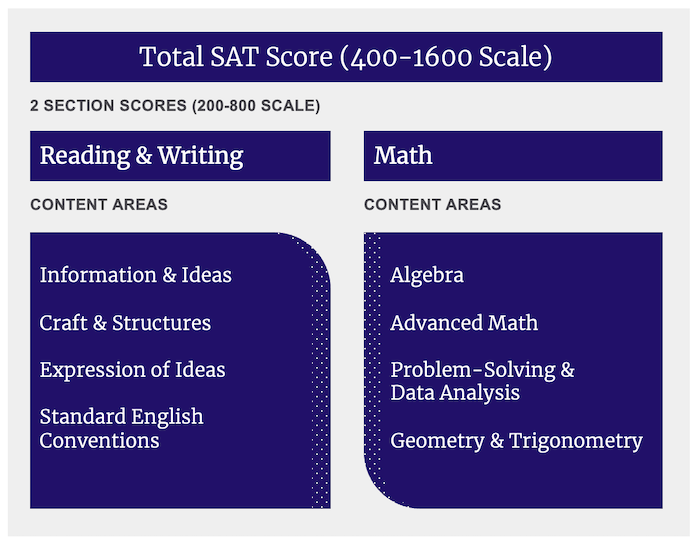
Now that you’ve seen what a good SAT score is at top universities, we’ll break down how the SAT scoring system works. SAT scoring is based on a 1600-point scale, with two sections—Math and Reading and Writing—scored between 200 and 800. There is no penalty for incorrect answers, so your raw score is the sum of the number of questions you answer correctly. SAT raw scores are converted to scaled scores, which are used to determine percentile ranks. The percentile indicates how well you did compared to other test takers. For example, if you score in the 72nd percentile, you did better than 72% of SAT test takers. This process ensures that your score is not affected by different forms of the test or other students’ ability levels. This scaled score is what you will see when you get your scores.
Scoring on the Adaptive Digital SAT
The Digital SAT is adaptive. How well you do on your first module of either Reading and Writing or Math determines the questions you see in the second. This is often called a multi-staged test. Doing well on the first module, also known as the routing module, will send you to a higher-difficulty second module. This will give you a chance to earn the very top scores for a section (either Reading and Writing or Math).
Keep in mind that even if you are routed to an easier second module, you can still earn a competitive score on the SAT. Don’t spend time trying to figure out which difficulty level you were routed to; this will only waste your brainpower and time. Your focus should be to do your best on every question, regardless of the module. While the SAT’s exact formula is proprietary, your total SAT score is based on how you do on both modules of Reading and Writing and both modules of Math. There is an overlapping range of scores possible for students routed to the easier or harder second module.
SAT Scoring Factors
The SAT is scored on a 200 to 800 scale in each section in 10-point increments. The two sections (Reading and Writing and Math) will have scores provided separately. This relatively small scale means that small improvements in your score can make a big difference in your percentile rank. For example, a 10-point increase in your score could boost your percentile rank by several points.
SAT Score Ranges & Percentiles
Below are SAT scoring ranges and percentiles according to data from the College Board.
Does my SAT score determine which college will accept me?
Your SAT score does not determine which college will accept you, but a good SAT score can help differentiate your application, even if the SAT is optional at the school you are applying to. Whether or not you are admitted to a college program (and whether or not you receive scholarship money) can depend on several factors. In addition to focusing on achieving the best SAT score possible for you, you should also work on obtaining the best GPA possible, writing a spectacular personal statement, taking a challenging course load, and rounding out your application with extracurriculars.
Test-Optional College Admissions
Some colleges have decided to make SAT test scores optional as part of their application requirements. This may sound like a good idea, but if you are looking to have your application stand out, a good SAT score is still one of the best ways to do that. Just because a school has decided to allow applicants to exclude SAT test scores does not mean other applicants are not continuing to submit SAT scores when applying.
How to Set a Target SAT Score
To set a realistic target SAT score, research the SAT score ranges of your top-choice schools. Aiming for the 75th percentile would make you a highly competitive applicant. Start by taking a timed practice test to establish a baseline score, then align your goal with both admission requirements and potential merit-based scholarships.
Here are the steps to setting a target SAT score:
- Research your top schools. Use college databases, such as BigFuture or U.S. News, to find the SAT score ranges in which most admitted students fall.
- Analyze the gap. Compare your baseline SAT score to your target. A 100 to 150 point increase is an achievable goal with consistent SAT prep.
- Check scholarship requirements. Research if hitting a specific SAT score triggers automatic tuition discounts at your preferred universities.
How to Improve Your SAT Score
Improving your SAT score by even ten points can increase your chances of getting into your dream school. Kaplan offers a wide range of free prep resources to help you succeed on the SAT, including:
- SAT Question of the Day: Raise your SAT score with free daily practice questions delivered straight to your inbox!
- Free SAT Practice Test: See how you would score with an SAT practice test and get a detailed report of your strengths and weaknesses.
- SAT Study Plans: Whether you are studying for three months or have just one month before test day, we have an SAT study plan to help you stay organized.
- SAT On Demand Free Trial: Try Kaplan’s SAT Prep On Demand Course free for seven days and see how our experts can help you maximize your SAT score.
SAT Preview Quiz
Find out how you would do on the SAT by practicing with our quick quiz!
SAT/ACT Score Conversion Calculator
Quickly convert your SAT score to an ACT score using our free calculator.
Written by Kaplan experts, reviewed by Melissa McLaughlin, Pre-College Content Developer and Heather Waite, Director of Content and Curriculum, Pre-College at Kaplan North America.