

Digital SAT Guide: What You Need to Know to Prepare
The SAT is a fully digital test that all students, with the exception of certain students with accommodations, take on a computer. You’ll receive a score out of 1600 that schools can use to help assess your college readiness. The digital SAT format has helpful built-in features, such as a graphing calculator, text annotation tools, a timer, a zooming tool, and the ability to “cross out” answer choices you want to eliminate. These features will make it easy for you to navigate the test and manage the questions. In this guide, we’ll break down what you need to know about the digital SAT, including what’s tested, scoring, how to study, and more.
TABLE OF CONTENTS
- Digital SAT Structure & Timing
- Digital SAT Scoring
- What’s Tested on the Digital SAT
- Where and When to Take the Digital SAT
- How to Study for the Digital SAT
- Free Digital SAT Prep Resources
- Digital SAT FAQs
- Digital SAT Quiz
Digital SAT Structure & Timing
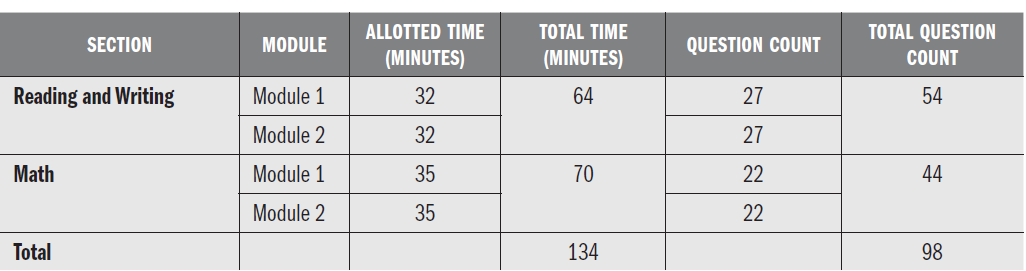
The digital SAT is 2 hours and 14 minutes long. The exam consists mostly of multiple-choice questions in two main sections: the Reading and Writing section and the Math section. Each section is divided into two modules. The two-module format divides each SAT section into two parts, each timed separately (see table below).
Is the digital SAT an adaptive test?
Yes, the digital SAT is an adaptive test; therefore, once you submit your answers for the first module of either the Reading and Writing or the Math section, you won’t be able to return to that module. Your performance on the first module of each section will determine the difficulty level of the second module you’ll take.
Doing well on the first module, also known as the routing module, will send you to a higher difficulty second module. This will give you a chance to earn the very top scores for a section (either Reading and Writing or Math). Bear in mind that even if you are routed to an easier second module, you can still earn a competitive score on the SAT. Don’t spend time trying to figure out which difficulty level you were routed to; this will only waste your brainpower and time. Your focus should be to do your best on every question, regardless of which module it is in.
Digital SAT Scoring
While College Board’s exact formula is proprietary, your total SAT score is based on how you do on both modules of Reading and Writing and both modules of Math. There is very likely an overlapping range of scores possible for students routed to the easier or harder second module. You will receive one score ranging from 200 to 800 for Reading and Writing and another for Math. Your overall SAT score will range from 400 to 1600 and is calculated by adding these two scores together.
The SAT also gives you a percentile ranking, which allows you to compare your scores with those of other test takers. For example, a student who scored in the 63rd percentile did better than 63 percent of all others who took that test.
The SAT scores that you need depend primarily on which colleges you are planning to apply to. For example, if you want to attend an engineering school, you’ll typically need a higher math score than if you want to attend a liberal arts college. Research the colleges you are interested in, find out what scores they require, and structure your SAT studying accordingly.
[ LEARN MORE: What’s a Good SAT Score? ]
What’s Tested on the Digital SAT
If you want to maximize your SAT score, you need to know exactly what skills are being assessed. Here is a comprehensive breakdown of the content domains tested on the digital SAT.
The Digital SAT Reading and Writing Section
Instead of separate sections for reading comprehension and grammar, the digital SAT combines them into one unified experience. You will tackle 54 questions split across two 32-minute modules. Every single question is paired with its own short passage (ranging from 25 to 150 words). The College Board groups these questions into four key content domains:
- Craft and Structure (~28% of the section): This domain tests vocabulary, rhetorical purpose, and your ability to connect two related texts. You will need to figure out the meaning of words in context and analyze how an author structures their argument.
- Information and Ideas (~26% of the section): This domain focuses on comprehension. Can you locate central ideas and details, find supporting textual evidence, make logical inferences, and interpret simple data tables or bar graphs?
- Standard English Conventions (~26% of the section): This is your classic grammar check. You will edit sentences to correct punctuation, subject-verb agreement, verb tenses, and sentence structure.
- Expression of Ideas (~20% of the section): These questions ask you to act as an editor. You will use a brief list of student notes to achieve a specific rhetorical goal or choose the best transition word to make a paragraph flow seamlessly.
The Math section consists of 44 questions divided into two 35-minute modules. Roughly 75% of the test features traditional multiple-choice questions, while the remaining 25% requires Student-Produced Responses (SPRs), on which you type in your own numerical answer.
The most student-friendly upgrade here is that a calculator is permitted on the entire Math section. Even better, a powerful graphing calculator—Desmos—is built directly into the Bluebook™ testing application.
The mathematical concepts are broken down into four foundational areas:
- Algebra (~35% of the section): You will solve linear equations, manipulate linear inequalities, evaluate systems of two equations, and analyze real-world scenarios involving unit rates and linear functions.
- Advanced Math (~35% of the section): This area prepares you for higher-level STEM courses. It focuses heavily on quadratic and exponential functions, polynomial operations, absolute value expressions, and solving nonlinear equations.
- Problem Solving and Data Analysis (~15% of the section): This area tests your quantitative literacy. You will interpret data using percentages, ratios, and proportions; calculate probability; and analyze statistical claims using scatterplots, graphs, and measures of center (mean, median, and mode).
- Geometry and Trigonometry (~15% of the section): This domain tests your understanding of shapes and lines. You will calculate area and volume, apply right triangle trigonometry, solve circle equations, and utilize foundational geometric theorems regarding lines and angles. Basic geometry formulas are provided on the exam.
Where and When to Take the Digital SAT
The SAT is offered every year on multiple Saturday test dates. Typically, exams are offered in August, September, October, November, December, March, May, and June. You can take the SAT multiple times. Some states offer special administrations of the SAT on different dates. Sunday tests are available upon request for students who require religious or other exemptions. The SAT is administered at high schools around the country that serve as testing centers. Your high school may or may not be a testing center. Check the College Board website for a list of testing centers near you. Note that you must register for the SAT approximately one month in advance to avoid paying a late fee.
How to Study for the Digital SAT
According to Kaplan SAT experts, studying for the digital SAT requires a strategic mix of test format familiarity, scheduled study time, and specific test-taking methodologies. Kaplan’s experts recommend focusing your study plan around the following core strategies:
Establish a Baseline and Create a Calendar
Start your SAT prep by taking a realistic, full-length digital practice test to establish a baseline score. Then create a study plan to help you keep your prep on track. Map out a calendar by writing down your non-negotiable commitments first (school, sports, work). Then, schedule specific, shorter blocks of time for SAT prep rather than trying to cram in massive sessions. Kaplan emphasizes consistency over cramming, suggesting 2 to 3 hours of focused study per week.
Master the Kaplan Method for Reading and Writing
Since the digital SAT uses short passages with only one question each, Kaplan teaches a three-step framework to maximize speed and accuracy:
- Step 1: What is the question asking?
- Step 2: What do I need to look for in the passage?
- Step 3: What answer strategy is best?
- Predict and Match
- Eliminate
Practice the Math Problem-Solving Method
For the Math section—where the built-in Desmos calculator is permitted throughout—Kaplan experts advise a 4-step systematic approach. For each question, ask yourself:
- Step 1: What is the question asking?
- Step 2: What does the question tell me?
- Step 3: What strategy is best for me? Kaplan experts urge students to look at math problems like puzzles, utilizing strategies such as Backsolving by testing answer choices or Picking Numbers to substitute for variables, rather than always relying on traditional, time-consuming calculations.
- Step 4: Am I done? Double-check if you are truly done and if the answer makes logical sense.
Free Digital SAT Prep Resources
If you want to kickstart your preparation without spending a dime, Kaplan offers several excellent free SAT prep resources. These tools are designed to help you gauge your baseline score, practice test-taking strategies, and get a feel for the digital exam interface.
- Free Digital SAT Practice Test: Experience a realistic, adaptive simulation of the exam through an interface that mimics the official Bluebook app, complete with a detailed score report breaking down your strengths and weaknesses alongside free access to KapAdvisor, Kaplan’s AI college admissions counselor.
- Free SAT Live Online Trial Classes: Attend a live, expert-led online course for free to learn Kaplan’s core test-taking methodologies, featuring a team of teachers available via private chat to answer your questions in real-time.
- Free SAT 20-Minute Workout: Sharpen your skills quickly with a timed, 12-question quiz that mimics actual exam difficulty and provides step-by-step answer explanations.
- Free SAT Question of the Day: Build a consistent study routine by receiving a fresh, individual exam-style question with a detailed answer explanation delivered straight to your inbox daily.
- Free SAT Pop Quiz: Take a rapid-fire quiz to quickly check your knowledge on specific question types and instantly review the correct answer logic.
Looking for support in your SAT journey? Check out Kaplan’s wide range of SAT prep courses for every learning style.
Digital SAT FAQs
Below, we answer some frequently asked questions about the digital SAT.
When did the SAT go digital?
The SAT went completely digital in the United States in 2024 and in other countries in 2023. The PSAT went digital as of Fall 2023.
How is the digital SAT different from the old version?
Compared to the previous pencil-and-paper version of the SAT, the digital SAT is shorter in length and has shorter, more accessible questions. All this is good news for test takers like you! You now have more time to spend per question, allowing you to do your best work on each question. And since the Reading and Writing passages and the Math questions are generally shorter in length, it’s easier for you to focus on what the questions themselves are asking.
Why did the SAT go digital?
There are several reasons that the SAT moved to an adaptive digital format. The digital SAT is more secure, as you (and every other student) will have a unique test. The adaptive nature of the digital SAT allows you to have an accurate score in less time. Another added benefit is that you have more time to answer each question. Overall, the digital SAT provides schools and families around the world with security and flexibility.
Is the digital SAT easier?
Yes, the digital SAT is easier than the previous paper-and-pencil version, according to students who have taken the exam and experts at College Board. The digital SAT is a full hour shorter (just over 2 hours), provides more time per question, allows a calculator (the built-in Desmos graphing calculator) across the entire Math section, and replaces multi-page reading passages with short, paragraph-length excerpts.
Digital SAT Readiness Quiz
Test your readiness for the Digital SAT by taking this quick quiz.
Written by Kaplan experts, reviewed by Melissa McLaughlin, Pre-College Content Developer and Heather Waite, Director of Content and Curriculum, Pre-College at Kaplan North America.