

The 3 Phases of Applying to Medical School
Becoming a doctor is something you’ve dreamed about for a long time, so it’s only natural you’d want everything to be perfect when you submit your application. That’s why we’re breaking down the med school application process into three simple phases. Medical school admissions are a rolling process, meaning decisions at each phase are made on an ongoing basis—not at any single predetermined point in the year. In fact, while schools have a final submission deadline, it is often ill-advised to wait until that date to submit, as spots may be full by then.
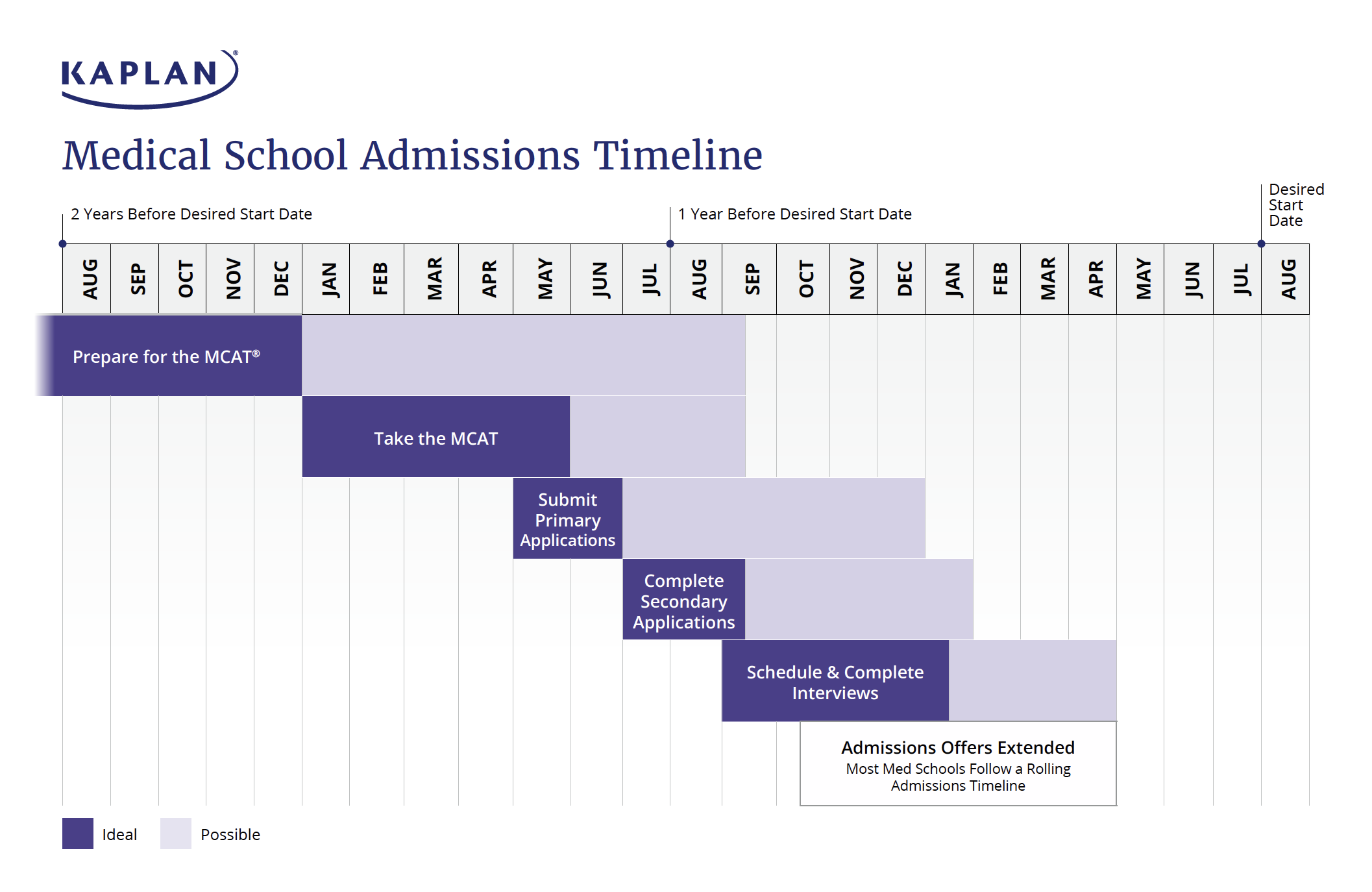
Here’s a quick overview of the three phases of applying to medical school:
Keep reading for a more detailed explanation of each phase.
[ READ NEXT: How to Plan Your Med School Application Timeline ]
Phase 1: The Primary Application for Medical School
The primary application is the first portion of your med school application you will submit, and generally, the earliest it can be sent is the end of May or first week of June of the application year, the year immediately before your first year of attendance. So, if you wanted to start medical school in the fall of 2027, for example, you would submit your primary application in either late May or early June of 2026. Part of the reason you want to submit early* is because you will be most competitive at this point and have the highest likelihood of being accepted. Medical schools accept students on a rolling admissions basis so spots will fill up as time goes by in the cycle. This means there is a higher chance of being accepted earlier on in the cycle because there are more spots available.
*This applies to both primary and secondary applications meaning you want to submit both as soon as possible without sacrificing quality.
The AMCAS/AACOMAS/TMDSAS Application Process
Most U.S. medical schools use either the American Medical College Application Service® (AMCAS®), which is the centralized medical school application processing service for the AAMC® that encompasses MD or allopathic medical schools, or AACOMAS, which is the centralized medical school application processing service for AACOM that encompasses DO or osteopathic medical schools. The great thing about AMCAS-participating schools and AACOMAS-participating schools is that, no matter how many med schools you apply to, you submit just one online application to AMCAS and/or AACOMAS.
If you apply to non-AMCAS and non-AACOMAS schools, however, you will have to fill out primary applications specific to each one, with the exception of Texas medical school applications, which use their own application service called TMDSAS. Before submitting, start gathering all the materials for your primary application. It’s best to begin this process in April or May.
Here’s an overview of the AMCAS/AACOMAS/TMDSAS application process:
- Request your official transcripts
- Start perfecting your personal statement
- Take inventory of your extracurricular activities
- Make sure you have taken your MCAT. Medical schools will only take their first action and review the primary application if it is considered complete. This includes having an available MCAT score.
Medical School Primary Application Timeline (May-June)
Starting in early May, the application services open for you to enter responses, grades, and a personal statement into the system so it’s ready to send in late May/early June, when submissions open. Try to submit your primary application as soon as possible. Don’t rush it, however. Once you submit the primary application, you can’t go back and change anything.
Phase 2: The Secondary Application for Medical School
There are two possible outcomes at this second phase in the application process: The medical school will reject your application, and the process ends there for that school, or the medical school will send you its secondary application. The secondary application is specific to each school you are applying to. This is where schools ask the specific questions they want answered. Many schools will just want an application fee and no additional info to continue the process, but some will ask you to write additional, school-specific essays.
The Situational Judgment Test for Med School
During this phase, you may also be required to complete a Situational Judgment Test (SJT). SJTs are designed to assess your “soft skills,” such as empathy, ethics, and professional judgment. There are two primary SJTs you will encounter: the CASPer® Test or the AAMC PREview® Exam. Most medical school applicants take SJTs in June or July, so their scores are ready when medical schools begin reviewing secondary applications. Remember: Not all medical schools require these. Check the AAMC MSAR® or individual school websites to see which tests you need.
Medical School Secondary Application Timeline (July-August)
The key to the secondary application phase is a fast turnaround. In an ideal world, you will spend much of July and August submitting secondary applications. To remain competitive, we recommend completing secondary applications within 14 days of receipt. Once schools receive your secondary application, they will review it along with the primary application and begin dividing students into three groups: those they will invite to an interview, those they will not, and the “maybes.”
Phase 3: The Medical School Interview
The medical school interview phase evaluates your interpersonal skills and mission fit through interviews lasting anywhere from two to six hours. Candidates typically undergo traditional interviews (one-on-one or panel) or Multiple Mini Interviews (MMIs), which test ethical reasoning via timed scenarios. These formal assessments are paired with informal student panels and tours to determine your soft skills and maturity. Following the med school interview, you can expect a decision within two to eight weeks based on the school’s rolling admissions policy.
If you do not get an interview from a particular medical school, they will notify you right away, and the process will end for that school. If a school wants an interview, they will also notify you, and you should schedule your interview at the earliest convenient time. Candidates in the third category, however, will not hear anything until that school moves them into one of the other two categories.
The Medical School Waiting List
Some candidates will not be rejected but will be placed on a waiting list that will be reviewed as candidates accept and decline offers. The medical school waitlist process is a dynamic waiting game that primarily hinges on the AAMC “Commit to Enroll” deadline of April 30th (also similar to AACOM). Most waitlist movement is stagnant during the winter but accelerates rapidly in May and June as accepted students are forced to relinquish multiple seats.
Depending on whether a medical school uses a ranked, tiered, or unranked waitlist, you can often influence your standing by submitting a “Letter of Intent” (promising to attend if accepted) or a “Letter of Interest” with significant updates, such as new publications or relevant experiences, if the school’s policy allows it. While some movement continues into July and even August, the vast majority of medical school waitlist activity occurs in the four to six weeks following the April 30th deadline.
Medical School Interview Timeline (September-January)
The peak of the medical school interview season occurs from September through January, when the highest volume of invites is issued and interviews are held. By February, the schedule begins to slow down as medical schools move toward finalizing their classes, though some programs continue to interview late-cycle applicants or waitlisted candidates into early April. Because most schools operate on rolling admissions, interviewing earlier in this window generally offers a higher statistical chance of acceptance, as more seats are available before the class begins to fill by late spring.
The medical school application process can seem overwhelming, but it’s completely manageable with the right planning. Successful medical school applicants are those who view each phase of the journey as an opportunity to put their best foot forward and showcase their best qualities. Looking for expert support on your journey to med school? Check out Kaplan’s medical school admissions consulting packages.
Written by Kaplan experts, reviewed by Dr. Alyssa Cole Mixon. Alyssa is a Physical Medicine and Rehabilitation doctor sub-specialized in Cancer Rehabilitation as well as a Kaplan Medical School Admissions consultant. In addition to being a doctor, she is also a content creator (@doctor.cole) and blogger (dailydoseofvita.blogspot.com), where she shares what life is like both in and outside of medicine while educating her audience on accurate health information.